Showing posts with label UEFA Champions League. Show all posts

Friday, June 22, 2012

Fingers Crossed for Excellence - UEFA 3rd Quarter Final

Fingers Crossed for Excellence - UEFA 3rd Quarter Final
Team reporter Graham Hunter has just one wish ahead of Spain's quarter-final against France – that it is excellence, rather than errors, which decides who makes the last four.
Before I name-drop, it's best to establish something up front. All of us who are asked to write these blogs, because we've been sent to cover one of the teams at UEFA EURO 2012, know just what a fantastic opportunity we've been given; if the position were advertised, there would be a queue from Gdansk to Gauteng full of hopefuls who wanted to cover Spain.
That said, Andrés Iniesta told me something the other day which brought tomorrow's match against France into even sharper focus. "We've reached the stage of the tournament, against sides with such equal levels of quality, that it's going to be about the side which reaches the opposition goal twice and scores at least once," he said.
That means, to me, that the side with the greatest efficacy, the fewest errors… perhaps the better luck, is the one which will progress. If the Spanish were to pick over their recent competitive history against France then they'd find errors; if the rest of us put a magnifying glass to the recent golden age of La Roja's football, you'd find almost none.
The ball taking on a life of its own and, somehow, squirming under the body of Luis Arconada in 1984 following a strike from Michel Platini is utterly iconic. How it went over the line remains a mystery, but it did and France won the EURO on home turf; Spain left in tears.
Then, in the UEFA EURO 2000 quarter-finals, Raúl González, of all people, misses a last-minute penalty and extra time is required. Again, France go on to win the tournament. And the 2006 FIFA World Cup? Despite leading 1-0, Spain ended up suffering a defeat which still rankles.
Now think of the modern Spain – Iker Casillas's miracle save in the 2010 World Cup final to deny Arjen Robben, his two penalty saves in the quarter-finals of UEFA EURO 2008. Then there is Cesc Fàbregas's winning penalty that day, Casillas's save against Paraguay in South Africa. It goes on – late winners against Sweden in 2008, Croatia in 2012, becoming the only team in history to lose the opening game of a World Cup and still go on to lift that trophy.
Moreover, winning 1-0 four straight times to become champions of the world equates to no errors at the back. We are in front of what promises to be a classic match and one where I hope it is excellence which prevails (for either side), and errors are thankfully scarce.

Share/Bookmark

Classy Khedira Pulls Strings for Germany - UEFA EURO 2012 Quarter-Finals

Classy Khedira Pulls Strings for Germany - UEFA EURO 2012 Quarter-Finals
Midfielder Sami Khedira played an integral role in Germany's dynamic attacking display as the Mannschaft dispatched Greece 4-2 to reach the UEFA EURO 2012 semi-finals.
The skill with which Sami Khedira dictated Germany's dynamic attacking game earned him the plaudits as the Mannschaft overwhelmed Greece 4-2 to reach the final four.
Khedira helped Real Madrid CF win the Spanish Liga alongside Mesut Özil, and that familiarity was evident as he linked up seamlessly with his team-mate to orchestrate Germany's attacks, feeding the playmaker on 18 occasions and ultimately topping the Castrol EDGE Index for his contribution with a score of 9.59.
Khedira was precise, completing every one of his short passes and 70 of his 78 total passes, resulting in a 90% completion rate – higher than anyone outside of Germany's back five. He was also incisive, making 11 passes into the attacking third, while only Bastian Schweinsteiger covered more ground.
Not only was his distribution first-rate, he also was a goal threat, missing the target just once from four shots, and scoring his second goal for his country. He may have to wait a while for his next, and may never get another quite as significant.

Giorgos Samaras had bundled in a Greek equaliser wholly against the run of play, and Germany needed to respond. Khedira did so in stunning fashion – Jérôme Boateng's cross picked out his late run into the box and a thumping volley flew past Michalis Sifakis in a flash. It was the ideal tonic for any possible German nerves and from there they strolled to victory.
Unsurprisingly Joachim Löw's charges dominated the match ratings and another goalscorer, Miroslav Klose, and industrious midfield metronome Schweinsteiger completed a German clean sweep.
Castrol EDGE Index: Germany v Greece
1. Sami Khedira (GER) 9.59
2. Miroslav Klose (GER) 9.29
3. Bastian Schweinsteiger (GER) 8.33

Key facts
15 – Germany's defeat of Greece brought their 15th successive competitive win, extending a national record.
11 – Germany have now scored 11 goals combined in their last three quarter-finals – this result following wins against Portugal, 3-2 at UEFA EURO 2008, and Argentina, 4-0 at the 2010 FIFA World Cup. Klose has hit four of them.
6 – With six goals, Germany v Greece is the highest-scoring match at UEFA EURO 2012.
17 – Klose has now struck 17 times in major international tournaments and requires just one more to equal Gerd Müller's all-time record. Ten of these goals have been headers.
– Greece have been behind in nine matches in EURO finals history, and not won a single one of them (D2 L7).

Share/Bookmark

Spot Luck Could Be in For England - UEFA Euro 2012 Quarter Finals

Spot Luck Could Be in For England - UEFA Euro 2012 Quarter Finals
Penalty shoot-outs at major finals tournaments generally end badly for England, but Andy James reckons Roy Hodgson's side are up for the challenge of the '12-yard lottery'.
Whenever England reach the knockout stages of a major tournament, most fans' initial reaction is one of optimism. Pessimism, however, soon follows. Why? Simple – the prospect of penalties.
Penalties have been the bane of many a promising England title bid over the past few decades. In the past 22 years, spot-kicks have spelled the team's demise on no fewer than five occasions – more than half of the tournaments they've been involved in during that time.
At the 1990 FIFA World Cup in Italy, Stuart Pearce and Chris Waddle were the fall guys as England were ousted by Germany in the semi-finals. It was the same story six years later at EURO '96 on home turf, where after winning a shoot-out for the first time against Spain in the quarters, Gareth Southgate's saved effort meant it was Jürgen Klinsmann and Co who progressed to the final.
England were again dumped out on penalties by Argentina in the last 16 of the 1998 World Cup in France, with David Batty and Paul Ince each failing to convert, before successive spot-kick losses to Portugal at UEFA EURO 2004 and the 2006 World Cup meant a trophyless end to Sven-Göran Eriksson's tenure.
With Roy Hodgson's side set to face Italy in the last eight of UEFA EURO 2012, many are predicting more penalty drama. Italy, though different from their predecessors in many ways, are the fathers of Catenaccio, while the current England side are renowned for their defensive asceticism. It's the ideal recipe for a draw.
Normally this would be cause for panic, but this time, astonishingly, the media are actually tipping England to win should it come down to spot kicks.
Much of this new-found confidence has been born of goalkeeper Joe Hart. England's first truly world-class shot-stopper in several generations seems to actively enjoy the '12-yard lottery'. "It's the situation where you get your chance to do your thing for the team," explained the 25-year-old, who also fancies taking one himself, if permitted. "I'll put my name forward 100%."
Hart laughed off the question of how many he'd been saving in training for fear of incriminating any of his team-mates: "I've not saved one because they're all so brilliant."
Joking aside, England do have some dependable takers. Hart has converted emphatically for England Under-21s and Manchester City FC in the past, while Ashley Cole was successful in the ill-fated shoot-out against Portugal in 2004, not to mention for Chelsea FC in this season's UEFA Champions League final against FC Bayern München. Wayne Rooney has also put away nine of his last 11 attempts for Manchester United FC.
Confidence is of course a major factor, but in reality no amount of training can prepare the players for the pressure situation of a shoot-out in a high-profile UEFA European Championship match. No matter how big the name or how great the talent, no player is impervious to the pressure of penalties. Remember Marco van Basten in 1992?

Share/Bookmark

Lahm Wants More from Careless Germany - UEFA Quarter Finals 2012

Lahm Wants More from Careless Germany - UEFA Quarter Finals 2012
Philipp Lahm said Germany can still improve, despite cruising into the semi-finals with a 4-2 defeat of Greece, while Sami Khedira was upbeat about their last-four prospects.
Germany captain Philipp Lahm lamented the fact Germany had "made life unnecessarily difficult" for themselves, despite easing through to the semi-finals with a 4-2 defeat of Greece. The FC Bayern München defender also warned his team they could scarcely afford to commit the errors which allowed Greece back into the game come next Thursday's last-four encounter with either England or Italy.
Philipp Lahm, Germany defender
We struggled, which we shouldn't have done. During the first 10-15 minutes, we had many opportunities to take the lead against a very defensive-minded Greece team. If you don't score in that time, things start to get difficult. We scored the first goal in the match, and then they scored, partly because we played too carelessly, and at some points also too slowly. We made some mistakes. We definitely have to avoid doing that in the semi-finals. We can be proud of having scored four goals today, and of reaching in the semi-finals.
We focused on creating chances all the time and Miro [Klose] did that very often. I think we managed to do it very well at the beginning, but then they improved defensively and in such situations, it is not easy to create chances to score. We did a good job. Of course, you have to take the lead a bit earlier. If you take the lead, you immediately have to keep going in the same way.
To be honest, I would love to score more often, but I am not the most dangerous player, I have to admit that. I am happy that I managed to score the first goal but I still think we made life unnecessarily difficult for ourselves.
Marco Reus, Germany forward
I'm glad we won the game and I'm also happy that I scored a goal. I think we dominated the match for 90 minutes, though we conceded an unnecessary equaliser. However, we contined to go forward, and tried to create chances. We were the better team, and Sami [Khedira] took on what was a very difficult volley to make it 2-1. After that, at 3-1, it was all over. I don't want to talk about who we might face, I'm simply glad we won, and we have to recover before the semi-final.
Sami Khedira, Germany midfielder
We are very happy about our win, but after half-time we made life very difficult for ourselves. However, after the equaliser, we kept our tempo high and deserved to win, even if it could have been easier. There was a lot of movement, we had many chances and we played a really good game.
The next game, whether it be against England or Italy, won't be easy, but if we're able to play to our full potential, we'll be very hard to beat.
Miroslav Klose, Germany forward
It was difficult. We expected the opposing team to be very compact, and they sometimes even employed a defensive line of five players but we can be very satisfied. We were able to achieve what we wanted to do, we played with quick combinations and created a lot of attempts on goal. We did a good job today. I am very happy. I scored a goal, and the team played so well. My family was here today, and that's why I am very happy.
Both [potential semi-final opponents] are very good. We played England in 2010, and faced Italy in Dortmund; they are also a great team. We will see what comes next. We are pretty relaxed, and we are looking forward to playing whoever we have to face in the next round.
Jérôme Boateng, Germany defender
It was a very exciting game. In the first half, we wasted a lot of chances, but then we scored the first goal, which was well-deserved. After the break, we conceded a sloppy goal, but we upped the tempo a little and deserved to win.
[The semi-final] is going to be an interesting match. Both teams will have their qualities, and I think both teams won't want to make the first mistake. It will be a thrilling game.

Share/Bookmark

Greece Proud to Have Gone Down Fighting

Greece proud to have gone down fighting
After their exit against Germany, Dimitris Salpingidis said Greece had "enjoyed every moment" of their campaign, with his team-mates proud of their achievements in Poland.
Greece know there was no disgrace in their 4-2 UEFA EURO 2012 quarter-final defeat against Germany, with Dimitris Salpingidis, Giorgos Samaras and Sokratis Papastathopoulos grateful for the support they received in Poland, and proud of the work that took them this far.
Dimitris Salpingidis, Greece forward
We fought as hard as we could. We were much better in the second half. We believed more in ourselves, and we managed to equalise. Unfortunately, these things happen in football. Germany scored a second goal, then naturally we pushed for another, and they scored again. The point is that we fought as hard as we could and we leave the tournament with our heads held high.
Everything has been really nice in Poland. We enjoyed every moment and the fact that we had to battle every day. We really loved it and we hope that our fans enjoyed it as well while they were watching our efforts. We have raised standards over the last ten years. Our next goal is to reach the World Cup finals in Brazil.
Giorgos Samaras, Greece forward
Germany are a very good team. We have managed to stand up to them, and we gave more than 100%. That is why we are proud to leave knowing that we did our best.
The Greek team have plenty of young players, including myself, as I am only 27. We still have a future in front of us. I am sure many other young players will join the team. A new campaign looking to Brazil starts in September, and I believe that everyone in this team, as well all Greeks, are hoping we will take part in those finals.
Sokratis Papastathopoulos, Greece defender
We definitely played against a great team today; we knew that from the very first moment. This is one of the best teams of the moment, and one of the best teams of the past five years. We did the best we could, and we scored two goals. Maybe we could have been more careful, but we put our soul into it, we did our best for Greece and for our people, and we really thank them for supporting us.
There is definitely a future for this team. The only thing we have to do is make a step forward each time we play in tournaments like this. We managed to be one of the eight best teams in Europe. That's a great achievement if you consider the Netherlands didn't even qualify, even though they are a very good team with players that are worth a lot of money. In my opinion, we did a great job, and we hope we will be even better in the future.

Share/Bookmark

Germany Class Fills Joachim Löw with Optimism

Germany Class Fills Joachim Löw with Optimism
Joachim Löw believes his Germany team have enough youth and quality to continue shining for years to come while his Greece counterpart Fernando Santos is already planning ahead.
Germany coach Joachim Löw said he was proud of his players after they produced another impressive performance that saw them past Greece and into the semi-finals of UEFA EURO 2012. His opposite number, Fernando Santos, admitted his side lost out to the better team.
Joachim Löw, Germany coach
First of all, I would like to say it was a fantastic performance from our team. For the fourth time in a row, we have qualified for the semi-final of a major tournament. Nobody thought we could have done that back in 2004. We have won 15 games in a row. We are the youngest team at this tournament and have great prospects for the future. I am proud of my players. We absolutely deserved to win tonight.

Greece scored two goals out of one chance. We were good from the start but perhaps the only thing I can say is that we didn't take advantage of our chances early on. I was irritated at that stage and my emotions are expressed at times like that.

After three wins here, I wasn't dissatisfied with my team in the slightest, but I had been planning on making the changes to the lineup for a while. I thought we had to be unpredictable against Greece, because I felt they would be ready for us. It is good to be cheeky like that from time to time. I thought the plan worked out quite well. Looking ahead, I think the four teams in the semi-finals will be serious contenders for the title. We know from now on games of this magnitude are decided by small details, and we can't allow a single mistake.

Fernando Santos, Greece coach
Firstly, I would like to congratulate Germany, who played really well and got their win. I would also like to congratulate my team for all of the efforts they put in throughout this tournament. In tonight's game, we didn't find much space, and they had the majority of possession. We should have looked to hold on to the ball more, but we practically couldn't breathe at times. Despite our efforts in defense, we conceded a first goal that made things more difficult for us.

During the break, we told the players to try to correct some defensive mistakes while taking more initiative in attack. I told them that if we scored, the game would change. We went out with determination and scored, but we then conceded again quickly and that clipped our wings. My players deserve credit though because they fought until the very last minute. 
[We were missing the suspended] Giorgos Karagounis, who is a very important player for us as he can keep the ball which gives his team-mates a breather. Had we had that we would not have conceded four goals. We weren't expecting so many changes to Germany's lineup. Their coach wanted to change to freshen things up, and for me it was the right move on his part. We will try to correct a few things now and hope to be better at the beginning of the World Cup qualifiers.

Share/Bookmark

Slate Wiped Clean for Spain's Iker Casillas

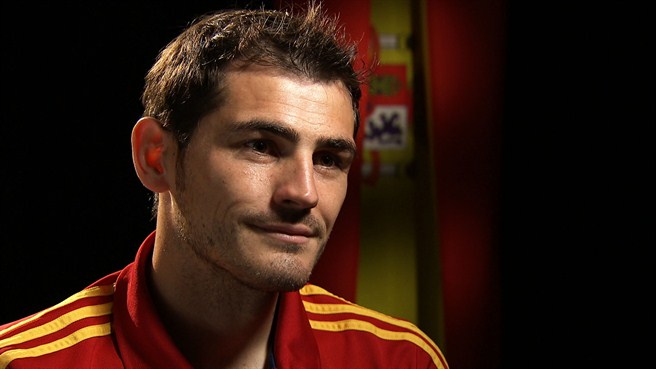
Slate Wiped Clean for Spain's Iker Casillas
After a tough group stage, Spain captain Iker Casillas told UEFA.com "nobody will remember what we've done before" as they reach the "all or nothing" phase of UEFA EURO 2012.
Still just 31, Iker Casillas is already a legend in Spain, with the national team captain – with 134 caps – the most-capped La Roja player of all time. However, the UEFA EURO 2008 and 2010 FIFA World Cup winner is still very much a crucial member of the current squad, as he showed in repelling an Ivan Rakitić header in the crucial 1-0 win against Croatia in Group C that took Vicente del Bosque's side into the last eight. With France next up in the quarter-finals, the Real Madrid CF No1 spoke to UEFA.com.
UEFA.com: The fact that Spain have never defeated France in a competitive match means nothing. Is that right or not?
Iker Casillas: There's no need to keep on looking at the stats or at results from the past. Those things can change in a moment. It's true that Spain have never defeated France in a competitive match, so we'll try to beat them now. But we'll not be thinking about that. We'll be thinking that we have a goal, which is to get through this stage and reach the semi-finals of the European Championship.
UEFA.com: It is partly down to your save from Ivan Rakitić against Croatia that Spain have made it this far. Was it a difficult one?
Casillas: Well, it wasn't a difficult save. Maybe it was a bit of a spectacular save, but I was in the way of the ball, right in the middle of the goal, and it was an instinctive jump where you hopefully get the ball. If Rakitić had headed it either side of me, I probably wouldn't have had a chance to save it.
UEFA.com: That game against Croatia was a tough one; have Spain chosen a good time to come alive?
Casillas: It was more like finding ourselves again by reaching the next round – the all or nothing stage. Nobody will remember what we've done before, whether we played well against Italy or badly against Croatia. People will remember what we've done stage by stage. Of course, our objective is to defeat France. And then we'll see what happens next.
UEFA.com: Do you feel that you are fully appreciated by the media back at home?
Casillas: The truth is that we've raised the standards so much. In the last few years we've become European and world champions, and now people demand that from us again. But people shouldn't forget that it's not that easy. There are other national teams that are changing and rebuilding their squads as well, which is also a significant factor. However, fortunately, I think I still have what it takes to play for a long time yet.
UEFA.com: Can you describe what it feels like to wear the Spain shirt?
Casillas: Responsibility. Pride. Satisfaction. Happiness. Commitment. Respect for those who have preceded me. An infinity of adjectives – and doing everything for the Spanish fans.

Share/Bookmark

Avid Pupil Blanc will Relish Spanish Test

Avid Pupil Blanc will Relish Spanish Test
Laurent Blanc is a huge fan of Spanish football and feels France are "a long, long way behind" their quarter-final rivals, but, as Matt Spiro explains, he knows Les Bleus can win.
Laurent Blanc has never tried to hide his admiration for Spanish football. The one season he spent in Spain – playing for Sir Bobby Robson's FC Barcelona in 1996/97 – was not an overwhelming success, yet the Spanish and Italian speaker clearly developed affinities for the country and has seized every opportunity to return to Camp Nou since.
Many long hours have been whiled away observing training sessions at La Masia or poring over Barça matches with France's video analyst, Thierry Marszalek. With the French Football Federation (FFF) currently introducing reforms in the training methods that are implemented at Clairefontaine, Blanc has contributed to discussions, helping the director of football, François Blaquart, put the Spanish-influenced coaching revolution in place.
"I love watching Spain and in particular Barcelona," the former Olympique de Marseille, Manchester United FC and FC Internazionale Milano defender told us earlier this week. "Their style is something we're trying to aspire to in France. It can't be adopted overnight, though, and for the moment we are a long, long way behind."
Blanc's admission may surprise some on the eve of Les Bleus' UEFA EURO 2012 quarter-final against La Roja. Do not be fooled, however. He is not ready to throw in the towel. It's just that Blanc knows France are not yet ready to try to beat the defending champions at their own game. He knows that if Franck Ribéry and Co try to out-'tiki-taka' Xavi Hernández, Sergio Busquets, Andrés Iniesta and Cesc Fàbregas, there will only be one winner.
"We usually try to focus on our own game as much as possible, but this time we'll have to adapt to our opponents," Blanc conceded at tonight's press conference. In other words, attacking midfielders like Samir Nasri, Ribéry, Hatem Ben Arfa, Mathieu Valbuena and Jérémy Ménez – depending on Blanc's selection – will be asked to work their socks off when Spain have the ball, especially in the early stages. "We know if we defend well and remain compact for the first 20 to 30 minutes, then we may have a chance," Blanc stressed.
As a connoisseur and lover of the Spanish game, Blanc is under no illusions. He laughed when a Spanish journalist asked if he thought criticism of Vicente del Bosque's team is justified: "Personally, I'd never criticise the way this Spain side plays because I love watching them." Yet for all his flattering words, Blanc knows that if France can defend well enough, they too have players capable of hurting the world champions on the counterattack.

Share/Bookmark

Del Bosque Willing Spain to Break with History

Del Bosque Willing Spain to Break with History
Laurent Blanc is preparing his France side to be deprived of possession against Spain, while Vicente del Bosque knows his team must "change history" to reach the last four.
Many people already have Spain pencilled in as the first side to win successive UEFA European Championships and the first to win three major tournaments on the trot – in short, a team destined to pen a new chapter in the long narrative of international football on 1 July. For coach Vicente del Bosque, though, they must rewrite the history books far sooner.
La Roja have never beaten France in a competitive fixture, most recently losing to them in the 2006 FIFA World Cup quarter-finals. Since then, however, they have torn up the back catalogue of records and precedents and suffered only one defeat in qualifying or major tournament football – against Switzerland in South Africa two years ago.
"Everybody thinks we're favourites because we won the EUROs four years ago and the World Cup two years ago," said Del Bosque. "But there's also evidence that France have always been better in competitive fixtures so we'll just have to see if we can change history. We are modest but optimistic."
All wry smiles and idiosyncrasies, Del Bosque can play it down all he likes, but the pedigree at his disposal brooks no argument. He admits he still has "some doubts about the starting lineup", but dilemmas such as choosing between a 'faux' centre-forward like Cesc Fàbregas, or a traditional striker like Fernando Torres, will hardly evoke sympathy from his rivals.
Del Bosque admitted as much himself: "We have great players and we have different options. I've always had 23 great players and I could use all of them – that's why I have doubts."
Though Laurent Blanc does not have such an embarrassment of riches, there is at least a silver lining to the cloud that is Philippe Mexès's suspension – Laurent Koscielny will come in for his first competitive international – while the "indispensable" Yohan Cabaye is back from a thigh injury and Franck Ribéry and Samir Nasri are both available following minor knocks. Whoever starts, Blanc knows all too well that they will have to dig deep in this mining hotbed.
"I usually say we have to adapt as little as possible to our opponents and play to our own strengths, but we're coming up against Spain, who have a very specific playing style," he said. "You are forced to adapt but the problem is that Spain have the ball 65 or 70% of the time and they won't give it back to you.
"We know Spain have dominated world football for four years but there are some signs that teams can trouble them. If you defend against Spain, if you stay compact, if in the first 20 to 30 minutes you show you really are in the game, then you are going to have an opportunity to win. First of all you have to fulfil these criteria or you can get punished."
Cautious words from Blanc, which to some might suggest an approach similar to the one which took Chelsea FC past FC Barcelona in the UEFA Champions League semi-finals. Del Bosque, for one, is not buying it. "I have a hard time believing they will just close the defense," he said. "They have players who can take the initiative. I don't see them waiting for us to do something."

Share/Bookmark

Cautious Joachim Löw will Resist Change - UEFA Euro 2012 Quarter Finals

Cautious Joachim Löw will Resist Change - UEFA Euro 2012 Quarter Finals
Some are suggesting Germany need an injection of new ideas from the likes of André Schürrle and Mario Götze, but Steffen Potter doubts that Joachim Löw is about to rejig his lineup.

Joachim Löw has two options in terms of team selection for Friday's quarter-final against Greece in Gdansk.

And no, I am not talking about who to field at right-back after Lars Bender, deputising for the suspended Jérôme Boateng, scored the winner against Denmark. It is a much more fundamental choice that Löw needs to make: namely, will he stick with the proven players who won him nine points in the 'group of death', or will he introduce some of the talented squad members who have spent most of the tournament on the bench so far?
The media in Germany have been focusing on the likes of André Schürrle (26 minutes), Toni Kroos (18 minutes), Marco Reus (zero minutes) and Mario Götze (zero minutes) over the past few days. And why not? Pundits, former internationals and plenty of coaches have come to the same conclusion: Greece will be very difficult to break down and the Nationalmannschaft could use some fresh impetus, more creativity and different ideas.
Götze could replace the tired-looking Mesut Özil, Lukas Podolski could make way for the lively Schürrle and Thomas Müller could stand aside for Reus, scorer of 18 Bundesliga goals this season. Some have even suggested, dare I say it, that three-goal hero Mario Gomez ought to leave his starting berth to the more versatile Miroslav Klose in this game. The defence (aside from the right-back) and Sami Khedira have been deemed untouchable, on the other hand.
I have to burst a few bubbles here, because Löw sees things differently. Defending is his most important principle at this tournament. Not in the sense that he wants his team to park the bus, but that he expects his wide midfielders to track back. A lot. He knows he will get that from Müller and Podolski as well, and has praised them repeatedly for it in the past weeks. He is not so sure about Reus, Schürrle or Götze in that regard.
He sees so much attacking quality in his side that he knows they hardly ever go without scoring a goal. But coming back from conceding a goal, especially against Greece, is an incredibly difficult – just ask Russia. The fact that he predicted that Özil's performances are "about to explode" proves he is far from replacing him. So I fully expect him to field the same starting XI as in the matches against Portugal and the Netherlands. What do you think?


Share/Bookmark

Greece's Hopes Vanished in Quarter Final - Germany Overpower Greece in Gdansk

Greece's Hopes Vanished in Quarter Final - Germany Overpower Greece in Gdansk
Philipp Lahm, Sami Khedira, Miroslav Klose and Marco Reus struck to send the 2004 winners home, though Greece were briefly level in Gdansk.
Greece's hopes of repeating the miracle of 2004 vanished with a 4-2 defeat against Germany, who marched on to the UEFA EURO 2012 semi-finals on the back of a fourth straight victory at these finals.
Germany took a deserved 39th-minute lead through Philipp Lahm and although Giorgos Samaras's equaliser ten minutes after the restart hinted at something unexpected, Joachim Löw's men reasserted their authority as Sami Khedira, Miroslav Klose and Marco Reus all found the net prior to Dimitris Salpingidis's late spot-kick.
It was a world-record 15th consecutive competitive win for a German side bidding to end a 16-year wait for a major honor, and should leave their confidence levels sky-high entering their Warsaw semi-final against England or Italy next Thursday.
For Greece, by contrast, this is the end of the road. They had entered the game without the suspended Giorgos Karagounis and José Holebas, and with worries over the fitness of left-back Giorgos Tzavellas – hardly the most promising backdrop to their biggest game since the final of UEFA EURO 2004, a victory famously overseen by a German coach, Otto Rehhagel.
That summer they kept upsetting the odds but in the first half there seemed zero likelihood of any surprise against opponents they have still never beaten. Germany's vibrant display certainly justified the team selection of coach Joachim Löw, who had sprung a surprise by introducing Reus and André Schürrle in the wide positions previously occupied by Thomas Müller and Lukas Podolski, as well as Klose for Mario Gomez at centre-forward.
Löw's plan was to provide some unpredictability along with speed and mobility and it worked, with Reus particularly impressive. The first scare for Greece came when Michalis Sifakis failed to hold Khedira's shot, and Klose turned in the rebound only to be flagged offside. If Sifakis collected a cut to the head in the process, very soon the whole Greece team had a headache as Germany, watched by Chancellor Angela Merkel, dominated.
The 23-year-old Reus had already sent one shot wide when, midway through the half, a slick interchange between him and Klose ended with Mesut Özil testing Sifakis. Klose and Reus both threatened again before Lahm struck, with his fifth goal in 90 appearances. Collecting Özil's pass 25 metres from goal he cut inside and sent in a swerving shot that brushed Sifakis's fingertips on its way into the far corner.
Greece have been slow starters in this tournament but they came to life at the start of the second half, equalising when Salpingidis put a low ball across goal and Samaras got there ahead Jérôme Boateng to squeeze it under Manuel Neuer.
Greece had done something similar to Poland in the opening match, but here they were unable to hold on to parity. Within six minutes, Boateng crossed from the right and the unmarked Khedira crashed a volley high past Sifakis. Germany would not let their lead slip a second time and Klose duly made sure by outjumping Kyriakos Papadopoulos and the flailing Sifakis to head the third.
When Sifakis blocked a Klose effort, Reus smashed in the rebound for Germany's fourth. Greece were out but Salpingidis's late penalty after a Boateng handball at least gave their fans one final thing to shout about.

Share/Bookmark

Italy Ready to Test England's Mettle - UEFA Euro 2012

Italy Ready to Test England's Mettle - UEFA Euro 2012
Roy Hodgson remains unbeaten in his five games as England manager but will face his biggest test yet against Italy in the last UEFA EURO 2012 quarter-final tie in Kyiv.
England will look to maintain their unbeaten record under Roy Hodgson when they take on Italy in the last UEFA EURO 2012 quarter-final in Kyiv.
Hodgson led England to first place in Group D but now faces an Italy side also unbeaten at this EURO, having finished runners-up in Group C. It is the teams' first meeting for ten years and only once before have they met at a UEFA European Championship final tournament, Italy winning 1-0 in 1980 to eliminate England.
• The winners will play Germany or Greece in the semi-finals in Warsaw on 28 June.
Head-to-head record
• Italy took nine attempts to beat England for the first time, Fabio Capello scoring in a 2-0 home friendly victory in 1973. The Azzurri nevertheless hold a slight head-to-head advantage with a record of W9 D6 L7.
• Although the nations first played in 1933 they did not meet in a competitive fixture until 1978 FIFA World Cup qualifying, trading 2-0 home wins – but it was Italy who made it to Argentina. The Azzurri have won four of their six competitive meetings, England just one.
Selected previous meetings
27 March 2002: England 1-2 Italy (Fowler 63; Montella 67, 90pen) – Elland Road, Leeds, friendly
England: Martyn (James 46), Mills (G Neville 46), Campbell (King 46), Southgate (Ehiogu 46), Bridge (P Neville 87), Beckham (Murphy 46), Lampard (J Cole 46), Butt (Hargreaves 46), Sinclair (Sheringham 70), Owen (Vassell 46), Heskey (Fowler 46).
Italy: Buffon, Cannavaro, Materazzi (Iuliano 57), Nesta (Adani 82), Zambrotta, Panucci (Coco 74), Doni (Tommasi 74), Di Biagio (Gattuso 57), Zanetti (Albertini 57), Totti (Montella 46), Delvecchio (Maccarone 74).
• Vincenzo Montella's double overturned Robbie Fowler's goal in the countries' most recent encounter, from which Gianluigi Buffon is the only survivor. Demetrio Albertini, now Italian Football Federation vice-president, appeared as a substitute.
11 October 1997: Italy 0-0 England – Stadio Olimpico, Rome, FIFA World Cup, qualifier
Italy: Peruzzi, Nesta, Cannavaro, Costacurta, Maldini (Benarrivo 31), Di Livio, Albertini, D Baggio, Inzaghi (Chiesa 46), Vieri, Zola (Del Piero 62).
England: Seaman, Campbell, Adams, Southgate, Beckham, Batty, Ince, Gascoigne (Butt 87), Le Saux, Sheringham, I Wright.
• England avenged a 1-0 home defeat earlier in this qualifying campaign by earning the draw that took them to the 1998 World Cup as group winners and left Italy to qualify via the play-offs. Hodgson was in Rome with Glenn Hoddle's squad and helped out as Hoddle's interpreter.
7 July 1990: Italy 2-1 England (Baggio 71, Schillaci 86pen; Platt 81) – Stadio San Nicola, Bari, FIFA World Cup, third-place play-off
Italy: Zenga, Bergomi, Ferrara, Baresi, Vierchowod, Maldini, Giannini (Ferri 90), Ancelotti, De Agostini (Berti 67), Baggio, Schillaci.
England: Shilton, Stevens, Parker, Walker, M Wright (Waddle 71), Dorigo, McMahon (Webb 71), Platt, Steven, Beardsley, Lineker.
• Italy claimed the bronze medal at their home World Cup thanks to Salvatore Schillaci's late penalty, which secured him the Golden Shoe.
15 June 1980: Italy 1-0 England (Tardelli 79) – Stadio Communale, Turin, 1980 UEFA European Championship, group stage
Italy: Zoff, Gentile, Collovati, Scirea, Tardelli, Causio (Baresi 88), Oriali, Benetti, Antognoni, Bettega, Graziani.
England: Shilton, Neal, Watson, Thompson, Sansom, Coppell, Wilkins, Kennedy, Keegan, Birtles (Mariner 75), Woodcock.
• Italy's narrow victory in their second game of the 1980 finals ended English hopes of finishing as group winners and reaching the final. Enzo Bearzot's hosts eventually finished second in the section behind Belgium and lost the third-place play-off to Czechoslovakia.
Form guide
• England have posted four wins and one draw under Hodgson and are now looking to reach only their second UEFA European Championship semi-final since 1968.
England's quarter-final record is two wins and two defeats:
1968 Spain 1-0 h, 2-1 a (3-1 agg)
1972 West Germany 1-3 h, 0-0 a (1-3 agg)
1996 Spain 0-0 (aet, 4-2 pens)
2004 Portugal 2-2 (aet, 5-6 pens)
European champions in 1968, Italy have a 50% success rate in EURO quarter-finals:
1968 Bulgaria 2-3 a, 2-0 h (4-3 agg)
1972 Belgium 0-0 h, 1-2 a (1-2 agg)
2000 Romania 2-0
2008 Spain 0-0 (aet, 2-4 pens)
• When Italy finished fourth in 1980 and reached the semi-final in 1988, there was no quarter-final stage.
Team ties
• Hodgson has had coaching spells in Italy at FC Internazionale Milano (1995-97, 1999) and Udinese Calcio (2001). In 1999, when serving briefly as caretaker coach back at Inter, he worked with Andrea Pirlo.
• Hodgson faced Italy four times as Switzerland coach, posting one win, one draw and two defeats. In 1994 World Cup qualifying, his Switzerland side earned a 2-2 draw in Cagliari and then won 1-0 in Berne before two 1-0 friendly defeats.
Hodgson enjoyed a famous win against Juventus during Fulham FC's run to the 2010 UEFA Europa League final, overturning a 3-1 first-leg loss with a 4-1 home victory in the round of 16. Claudio Marchisio played for Juventus in the first leg.
• As a Juventus player, Cesare Prandelli suffered a 1979/80 UEFA Cup Winners' Cup semi-final defeat by Arsenal FC but beat Manchester United FC at the same stage of the 1983/84 edition. He came off the bench for the last six minutes of Juventus's 1984/85 European Champion Clubs' Cup final victory over Liverpool FC.
Prandelli's ACF Fiorentina side beat Everton FC 4-2 on penalties after a 2-2 aggregate draw in the 2007/08 UEFA Cup round of 16. Riccardo Montolivo – a scorer in the Viola's 2-0 first-leg win – converted his spot kick in the shoot-out, while Phil Jagielka had his penalty saved. Joleon Lescott was also in Everton's team and Leighton Baines on the bench.
• Steven Gerrard headed the first goal when Liverpool fought back to draw 3-3 draw with Pirlo's AC Milan and win the 2004/05 UEFA Champions League final on penalties. Pirlo's deflected free-kick off scorer Filippo Inzaghi helped Milan avenge that defeat in the 2007 final.
• Wayne Rooney has struck ten goals in 14 UEFA Champions League appearances for Manchester United against Italian clubs. This included four goals in a 7-2 aggregate win against Pirlo's Milan in the 2009/10 round of 16 – although he was also on the losing side against them in the 2006/07 semi-finals.
• Rooney has scored four times in six appearances against Daniele De Rossi's AS Roma – including one goal in a 7-1 quarter-final win at Old Trafford in 2006/07 when De Rossi hit the visitors' goal. De Rossi missed a penalty at the same stadium when Roma lost at the same stage in 2007/08.
• John Terry scored in Chelsea FC's 4-1 UEFA Champions League round of 16 second-leg victory against SSC Napoli in March. Ashley Cole was also in Chelsea's lineup, while Morgan de Sanctis and Christian Maggio featured for Napoli. The Italy pair played against Manchester City FC's Joe Hart, James Milner and Lescott in the group stage.
• Theo Walcott got the winner in both legs of Arsenal's UEFA Champions League play-off success against Udinese Calcio last August. Antonio Di Natale scored but also had a penalty saved in Udinese's 3-1 aggregate loss.
Since Mario Balotelli has been a team-mate of Hart, Lescott and Milner at Manchester City since 2010, winning the FA Cup in 2011 and the club's first league title since 1968 a year later.
Alessandro Diamanti played alongside Robert Green and Scott Parker at West Ham United FC in 2009/10.
Fabio Borini was as a youth player at Chelsea and made four Premier League substitute appearances as a team-mate of Terry and Cole. He also had a three-month loan at Swansea City AFC in 2011.
• Ashley Young, Baines and Milner were in the England team that drew 2-2 with the Italy of Giorgio Chiellini, Antonio Nocerino and Montolivo at the 2007 UEFA European Under-21 Championship.

Share/Bookmark

Germany Coach Joachim Löw in UEFA Euro 2012

Germany Coach Joachim Löw in UEFA Euro 2012
Joachim Löw accepts that Germany are favourites to reach the semis at Greece's expense but refuses to take lightly a side sourcing inspiration from the biggest EURO shock of all.
Germany coach Joachim Löw issued a strong warning to those who believe his side can already begin planning for the UEFA EURO 2012 semi-finals: "Playing Greece will be akin to colliding with a rock."
The three-time European champions go into the tie at the Arena Gdansk on the back of a national-record 14-game winning run in competitive fixtures and, in eight previous meetings with Friday's opponents, have never lost. Yet one statistic weighs heavily in the other column: Greece triumphed at UEFA EURO 2004 when their ambitions were similarly dismissed.
"We are the favourites, that's logical and we can live with that," Löw said. "We also know that knockout games have their own character. Once the match starts, being expected to triumph counts for nothing. Greece are not the sort of team that gets ripped apart; we saw that against Russia when they upset the odds [winning 1-0]. You can never count them out."
Löw has made just one change to his starting lineup during a tournament which has so far brought wins against Portugal, the Netherlands and Denmark. With Jérôme Boateng available again after suspension and Bastian Schweinsteiger having shaken off an ankle complaint, the 52-year-old is not expected to radically vary his set-up for Greece, a team he describes as "dynamic, good defensively and dangerous on the counterattack".
"In a quarter-final you have to make a huge effort," added Löw. "We have so far shown we're fast, capable of creating problems for opponents and able to score good goals. If we run at them in the last third, look to play at a high tempo and display a killer instinct, we will be in a good position to beat them."
On their way to victory at UEFA EURO 2004, Greece defeated holders France at the quarter-final stage and their coach this time around, Fernando Santos, spelled out what his team need to do to match that achievement: "We must avoid all mistakes and be focused throughout. That is the only way we will be the team celebrating on the pitch afterwards."
Greece made errors in their opening game, but fought back from a man and a goal down to draw with Poland, then lost 2-1 to the Czech Republic before getting back on track with victory over Russia. On Friday they will be without suspended captain Giorgos Karagounis and full-back José Holebas but can take heart from the fact that the Czech loss is their only defeat in 13 games during this campaign.
A record as favorable as that makes their billing as David to Germany's Goliath seem somewhat overstated, but Santos is happy to go along with it. "David won that battle against an opponent who was never expected to lose so I'm OK with that," he said.
"It's true that in terms of stature and importance Germany are big and they always expect to get far in tournaments. However, we are not here on our holidays. The 2004 team was written off before that tournament and they are our source of inspiration now."

Share/Bookmark

More to Italy than Super Mario - UEFA Euro 2012

More to Italy than Super Mario - UEFA Euro 2012
With the English press's hopes of talking to Mario Balotelli falling on deaf ears, Richard Aikman wonders whether they realise Italy have more to offer than just the intriguing Manchester City FC striker.
When Leonardo Bonucci covered the Mario Balotelli's mouth with his hands after he scored against the Republic of Ireland he was more than just doing his team-mate a favour. He was towing the party line. Since the striker's arrival in Krakow Mario Balotelli has still not been heard publicly, and this week it has caused particular frustration among English journalists.
"Why is Balotelli not speaking?" asked one disgruntled member of the press pack. "He's the only story in town". A comment that speaks volumes for a certain insular mindset. There's more to Italy than just Super Mario.
Football writers love Balotelli because he makes their lives so much easier. Throughout the season rarely a week goes by without him getting in the news for some escapade, on or off the pitch. At times he writes the headlines by himself. Yesterday in training, for example, he and Antonio Di Natale broke the monotony of jogging by teaming up to trip Antonio Cassano.
But when it all goes quiet on the Mario front it means we all have to work a bit harder for our stories. The language barrier doesn't help, of course. When two player press conferences take place simultaneously at Casa Azzurri translators aren't provided for both, so those reporters at Alessandro Diamanti's press conference were left fuming on Wednesday when he would only answer questions in Italian and they were left, like Balotelli the other night in Poznan, muzzled.
Contrary to what some English scribes will have you believe, Italy are about much so more than their Manchester City FC striker. What about Cassano, who has been outstanding in his three matches so far, or Claudio Marchisio, whose tireless displays have made him the Azzurri's standout player to date?
Marchisio is a phenomenal athlete, as he showed once again yesterday when the players were put through interval sprint training under the burning sun. While Balotelli was the first to wilt under the gruelling examination of the Azzurri's fitness instructor, Marchisio barely broke sweat. He has clocked more kilometres (35) so far this tournament than any of his team-mates, and has shown a superhuman ability to break up attacks at one end and breaking into scoring positions at the other.
Italy are far from being a one-man team. They are a side that has run 328km at this EURO compared to England's 316; a side who can change their formation at will; quarter-finalists who are trying to win the tournament on the back of attractive, free-flowing football.
If England's players are as Balotelli-centric in their approach as some of their columnists, they will be in for an unpleasant surprise on Sunday.

Share/Bookmark

Portugal Can Finally Move On - UEFA Euro 2012

Portugal Can Finally Move On - UEFA Euro 2012
Supporters and journalists alike were full of nerves prior to Thursday's quarter-final but, writes Andy Brassell, victory against the Czech Republic was a cathartic experience for Portugal.

"Evening, mate. Confident?" Prior to kick-off last night at the National Stadium Warsaw, the greeting was the same from every Portuguese journalist this correspondent bumped into. Replying in the affirmative was met with a series of furrowed brows.

The impressive win against the Netherlands in Kharkiv seemed to have made the media less, rather than more, optimistic, even if Thursday morning's newspapers had puffed their chests and proclaimed: "We're going to the semi-finals" (A Bola).
Though Portugal were victorious against the Czechs at UEFA EURO 2008, minds were more occupied by EURO '96, and Karel Poborskŷ's legendary chipped winner in the quarter-final against Portugal in Birmingham.
Poborskŷ's successful two-and-a-half year spell at SL Benfica subsequently kept him in the forefront of Portuguese minds, and the now-retired midfielder has spent much of this week reliving the moment to Portugal's media.
"I was 14, it absolutely killed me," Australian journalist Vítor Sobral, from a Portuguese family, told me. Maybe now the footballing nation's scars will begin to heal, but it was touch and go for a while. As a series of chances came and went for Paulo Bento's side in Warsaw, it seemed a grisly repeat could be on the cards.
As Cristiano Ronaldo hit the post twice, and Hugo Almeida headed over, it felt as if Domingos' shot was being saved and Jorge Cadete was heading wide all over again. This time, though, there was Captain Ronaldo to come to the rescue. Wednesday's semi-final in Donetsk, therefore, will represent moving on in more ways than one.

Share/Bookmark

Michalis Sifakis Drawing Strength From Greek Grit

Michalis Sifakis Drawing Strength From Greek Grit
Greece are likely to be tested to the limit on Friday by quarter-final rivals Germany, but goalkeeper Michalis Sifakis feels their "persistence and talent" could be enough to go through.
Few may be backing them to beat Germany, but Greece have become masters of upsetting the odds in recent years. For goalkeeper Michalis Sifakis – the man charged with thwarting Mario Gomez and Co – their unique tenacity could well carry them past yet another seemingly insurmountable obstacle.
That Greece are in the quarter-finals at all is a superb achievement, Fernando Santos's side having stunned Russia 1-0 in their final Group A game to advance at the expense of the section favorites. That came after they had drawn 1-1 with co-hosts Poland despite being reduced to ten men, while their second outing produced a 2-1 loss to the Czech Republic that left them on the brink of elimination.
"We Greeks have an attribute that is not found in other people," said Sifakis, whose tournament began when he replaced the injured Kostas Chalkias after 23 minutes against the Czechs. "We're so persistent and eager to win that this goes beyond any kind of preparation, facilities, infrastructure or whatever else the other countries have. And it is something that also shows on the pitch."
Greece's passage to the last eight has inevitably revived memories of UEFA EURO 2004, when the Galanolefki left the watching world speechless by reaching the summit of the European game. Though the intervening years have brought little in the way of success, Sifakis sees similarities between the current squad and their illustrious predecessors, highlighting the strong team spirit in their ranks.
"It's the secret for the big successes of this team," he said. "If you go back to 2004, you can't possibly remember a single player standing out from the other 22. All players who participated fought like a single man and we managed to win the EURO."
One player involved in both squads is Giorgos Karagounis, whose goal against Russia proved so vital. Suspended for Friday's last-eight meeting with Germany in Gdansk, he will be sorely missed, but Sifakis sees no reason to fear Joachim Löw's side.
"They are a very strong team, that's true," he said. "They're the big favorites, but, like I said before, we Greeks have an attribute the other teams don't. We have persistence and talent. Unfortunately, we don't have the infrastructure they have in Germany, but our persistence helps us overcome all obstacles.
"They're the favorites, but Russia were also the favorites. We know our potential, we know what we have to do, we know what we must not do, so we are not stressed by the fact that we're playing against a strong team who are the favorites. The stress is on their side, not ours."
That certainly seems to be true of Sifakis at least, the Aris Thessaloniki FC custodian having been sidelined with a knee injury between September and March. Above all, he is thrilled to be taking part in the tournament after so long out of action. "The day I went into hospital to undergo surgery, this was the first goal I had in mind for when I recovered," he explained.
"In the end, I managed to recover earlier than predicted. I started training with the team towards the end of January. I thought I would be here, I really wanted it, and I'm delighted to have finally made it. That was a very difficult six to seven-month period for me, being absent for all that time."
Being out for so long also cost him his starting place in the national team after he had started the qualifying campaign as first choice, and it took Chalkias limping out of the fray against the Czech Republic for him to reclaim his spot – since when he has not conceded. "It was very difficult for me to go on in the 23rd minute, when we were already losing by 2-0 and our chances for the match were significantly reduced," he said.
"Our feelings were very strange, especially for me since I came on from the bench in such an important match. Either way, I'm very pleased that the team qualified for the quarter-finals. We never take each player's individual performance into consideration; everyone plays his own distinct role on the pitch and we all try to give our best so that we can win in the end." That approach could serve them well again on Friday.

Share/Bookmark

Wednesday, June 20, 2012

UEFA EURO 2012 Fan Zones - Jam Packed and Full of Fun

UEFA EURO 2012 Fan Zones - Jam Packed and Full of Fun
The fan zones in the eight UEFA EURO 2012 host cities have drawn some massive crowds, with over 4 million fans from around the world enjoying creating history together.
More than 4 million supporters have attended matches at the UEFA EURO 2012 fan zones in the eight host cities, with central locations and fabulous entertainment programs inviting fans from all nations to gather together in a safe environment to enjoy watching the group stage games on big screens. Sponsors love them, fans love them: see why with this whistle-stop tour around the fan zones.
Donetsk
Location: Sherbakova Park
Total attendance: 199,700

The fan zone near the old Shakhtar Stadium boasted an incredible 80,000 visitors on 11 June, when England played France before Ukraine took on Sweden. That night, 51 kegs of Carlsberg beer were drunk: "This is an absolute record among the host cities," fan zone director Igor Martynov said with pride. Some kind of endurance record was also set at the same fan zone, with 18,000 supporters refusing to leave despite the massive storm that struck the city at the start of France's 2-0 win against the co-hosts, causing the match to be suspended for 58 minutes. "There was no time to hide," Ukraine fan Vladimir told UEFA.com. "So I just walked to the nearest tent and ordered a beer. I knew it was not safe to hide under a tree during that kind of a storm, so I just stood under the open sky."
Gdansk
Location: Plac Zebrań Ludowych (People's Meeting Square)
Total attendance: 258,900

A performance from US hip-hop star Pitbull launched the fan zone, ahead of Poland's tournament opening fixture against Greece, with former Oasis guitarist Noel Gallagher billed to appear on 20 June. Some 48,000 watched the co-hosts' 1-0 defeat by the Czech Republic at the same venue and it has remained popular throughout the finals, benefiting from its relative proximity to the Arena Gdansk. Ali Farhat, a 27-year-old Parisian, was particularly impressed by the Gdansk facilities, saying: "Everything has been well organised. I've been to fan zones at previous EUROs and World Cups, and Gdansk matched those all the way."
Kharkiv
Location: Ploshcha Svobody (Freedom Square)
Total attendance: 598,900

Situated bang in the centre of the city, in one of the largest squares in Europe, Kharkiv's fan zone has profited from themed days, such as a circus festival, Netherlands day and Ukrainian cuisine day. Kharkiv Zoo's footballing Nostradamus, Fred the Ferret, has been in attendance every day too, attempting to predict football results (at last count he had guessed nine out of 20 correctly), while a stunning 160,000 supporters flocked to the fan zone on 13 June for the Portugal v Denmark, and Netherlands v Germany matches. Newly married couples have also made pilgrimages to the fan zone for wedding photos, with Dmytro and Iryna saying: "We simply couldn't have missed such a great opportunity. The fan zone is very beautiful and not many couples have a chance to get a photo in a place like this."
Kyiv
Location: Maidan Nezalezhnosti (Independence Square)
Total attendance: 1,194,000

On 11 June, 160,000 supporters descended on the capital's fan zone to watch England's game against France and then Ukraine's 2-1 win over Sweden, with the facility extended all the way to Bessarabka Square for the final round of Group D fixtures. Concerts, contests and competitions helped swell the attendance, as did the presence of Funytk the Pig, another emissary from the animal kingdom called in to predict the results of matches each day at 15.00CET. "We always come here with friends because every day there is something new," said Sweden fan Ulle. "The best ones were the body art festival and the day there were master classes on cooking Ukrainian national dishes. We cooked 'varenyky' – it was very funny."
Lviv
Location: Prospekt Svobody (Freedom Avenue)
Total attendance: 465,000

Right at the heart of the UNESCO-protected city centre, Lviv's fan zone has been the focal point for fan activity in the town. Its capacity is just 27,000, but an incredible 100,000 passed through its doors on 17 June, when Portugal played the Netherlands and Germany took on Denmark. Sponsor-led competitions and activities, including singing, dancing, football quizzes and freestyling, have helped keep spirits high. Solomia Koronenko, one of the directors of tournament activities in the city, said: "Lviv is the cultural capital of Ukraine, so the fan zone had to be of a high standard." The Crown Prince of Denmark was one of the notable VIPs to experience the fan zone, yet locals enjoyed it too, with one Ukraine supporter from nearby Ternopil saying: "It is incredible here. I never would have believed it would be so cool. I've come more than 150km to get here and I'm glad I did."
Poznan
Location: Plac Wolnosci (Freedom Square)
Total attendance: 333,250

In Poznan, UEFA EURO 2012 will be remembered as much for the Irish and Croatian fans that flooded in to the city as for the football, with the fan zone proving a major draw despite the wealth of other places to eat, drink and relax in this quietly beautiful city. Plenty of musical turns helped keep things busy, while a junior zone catered for younger supporters and sponsors ensured there were plenty of activities to suit everyone. What supporters will look back on is the friendly atmosphere in Freedom Square, even though the Irish and Croatians did not have reason to stay in Poland and Ukraine beyond the group stage. On the final match day in the city, volunteers in the fan zone erected a sign bearing the words: "Fans of Croatia, Ireland and Italy: You are great." Indeed they were, and Poznan made them welcome.
Warsaw
Location: Plac Defilad (Parade Square)
Total attendance: 821,756

The largest and perhaps loudest of the UEFA EURO 2012 fan zones, Warsaw registered an attendance of 160,000 for the opening day of matches, with all subsequent Poland games bringing well over 100,000 locals and visitors into Parade Square, in the shadow of the capital's imposing Palace of Culture and Science. Seven giant screens enabled fans to keep in touch with the action, though it was definitely standing room only whenever the co-hosts were in action. While Warsaw has not seen the huge numbers of foreign fans noted elsewhere, locals have taken the fan zone to their hearts, and tellingly Franciszek Smuda's side chose to say their farewells to supporters here after their elimination from the tournament. Another massive crowd greeted their arrival with chants of "Thank you, thank you", "We are with you, Poland, we are with you" and "Poland, white and red".
Wroclaw
Location: Plac Rynek (Market Square)
Total attendance: 372,900

Wroclaw's location close to the border ensured 90,000 were at the fan zone on the day the Czech Republic met Poland in the city, with Czech fans taking the train to share in the excitement of UEFA EURO 2012. Greek and Russian supporters also turned up in decent numbers as the daily entertainment on offer in the fan zone proved to be as much of a draw as the excellent weather. The fan zone will stay open until the end of the championship – and Wroclaw knows that it has helped to advertise the city worldwide. "During the EURO, Wroclaw has been colourful, loud and very friendly," said local fan Dawid. "The EURO atmosphere engulfed the city and the atmosphere in the fan zone during Poland's matches was incredible."

Share/Bookmark

Greece Keeping Things in Perspective - UEFA EURO 2012

Greece Keeping Things in Perspective - UEFA EURO 2012
Football has always been more than a sport, but Vassiliki Papantonopoulou feels Greece's players should focus on enjoying themselves as they prepare to face Germany on Friday.
Germany 0-1 Greece. And a winning goal scored by Socrates. No, I'm not sharing a dream with you (although I wouldn't mind a similar turn of events on Friday). Instead, I just re-watched the classic Monty Python sketch of a football match pitting Germany's modern philosophers against Greece's wise men of antiquity.
Football has always transcended the mere barriers of sport. It can inspire art, interrupt high-level political discussions (remember the recent G8 summit when world leaders paused to watch the penalty shootout between Chelsea FC and FC Bayern München?), boost economies or change social life. It has always been more than just a game – for us, the fans and spectators.
But do the players share that feeling? Do they feel the weight of expectations or see how any one football match can touch so many aspects of life?
Yesterday, at Legionowo, where the Greece team train every day, the press came looking for answers that might indeed prove that Friday's quarter-final can transcend barriers and be about something more than football during difficult economic times. But neither Giorgos Samaras nor Kyriakos Papadopoulos obliged. "It's sport, it's a game," they said. "We go on to the pitch to enjoy ourselves and do the best we can."
The Greek team were called to do a tough job and passed with flying colours. They know that their showings in UEFA EURO 2012 will have positive repercussions on the country's low morale: "We want to make people back in Greece happy, to give them something to celebrate," said Samaras.
As far as I'm concerned, that's the right spirit. To borrow, again, from the Monty Python team: "Always look on the bright side of life." A coach and his players are participating in a feast of football and are looking to enjoy it and do their best for themselves and their country. That's what sport is all about. Nothing more, nothing less.

Share/Bookmark

Netherlands' Mark Van Bommel Steps Aside

Netherlands' Mark Van Bommel Steps Aside
Netherlands midfielder Mark van Bommel has called time on his international career after the Oranje's exit from UEFA EURO 2012, saying "it is time for talented young players."
Mark van Bommel has ended his international career in the aftermath of the Netherlands' early exit from UEFA EURO 2012.
Van Bommel started both of the Oranje's opening two Group B games as captain but was an unused substitute for their final fixture – a 2-1 defeat by Portugal which left them bottom of the section without a point. The midfielder, who won 79 caps, announced on Wednesday that he is not set to appear again for his country.
"I don't want to retire," said Van Bommel, 35. "Maybe there will be a moment that the coach needs me in the future and then I will be available, but for now it is time for talented young players."
Van Bommel, who counts FC Barcelona and AC Milan among his former clubs, has agreed to return to PSV Eindhoven in his homeland for next season.

Share/Bookmark

Attacking Spring Back in Portugal's Step

Attacking Spring Back in Portugal's Step
With Cristiano Ronaldo among the goals and spirits high before Portugal's quarter-final, Andy Brassell believes Thursday's encounter with the Czech Republic could be lively.
As the rain lashed down on the Portugal squad in Opalenica this morning, it failed to dampen spirits. While their team-mates went through a light session, Ricardo Quaresma and Nélson Oliveira broke away to try shooting at goal from the halfway line. The former found the net and the latter narrowly missed, prompting much laughter and jostling from Quaresma for the young SL Benfica forward.
Neither player is likely to start tomorrow's Warsaw quarter-final against the Czech Republic, but two things were evident from this short passage of frivolity. Firstly, Portugal are enjoying themselves at UEFA EURO 2012. Secondly, there is a permanent dedication to an attacking approach throughout the squad.
Many presumed this wasn't the case after the opening match with Germany, as Portugal were judged on a cautious mindset, allied to a dry spell in front of goal in pre-tournament friendlies. This ignored the fact that, until this mini-run of profligacy in 2012, the Selecção das Quinas had been on a rampage under Paulo Bento, finding the net 37 times in his first 13 matches in charge.
As the world at large focused on Cristiano Ronaldo's personal struggles in front of goal after the win over Denmark, that Portugal had scored three times and created a host more chances was reduced almost to a footnote. The captain hit all the right notes against the Netherlands in spectacular fashion, yet the team's intent in Kharkiv was just the same as it had been in the previous game in Lviv.
It is unlikely that there will be any let-up against Michal Bílek's Czech side. His right-back, Theodor Gebre Selassie, has been one of the stars of the tournament, getting forward with gusto throughout. However, just as the Netherlands' offensive approach left room for Ronaldo to attack, the space behind Gebre Selassie seems sure to invite a reprise from both the captain and Fábio Coentrão. Fireworks lie ahead in Warsaw.

Share/Bookmark